When to Use It
Use Cellular when you need cell-based patterns and noises that can be quite versatile as they're ever-present in nature.
Visual Direction
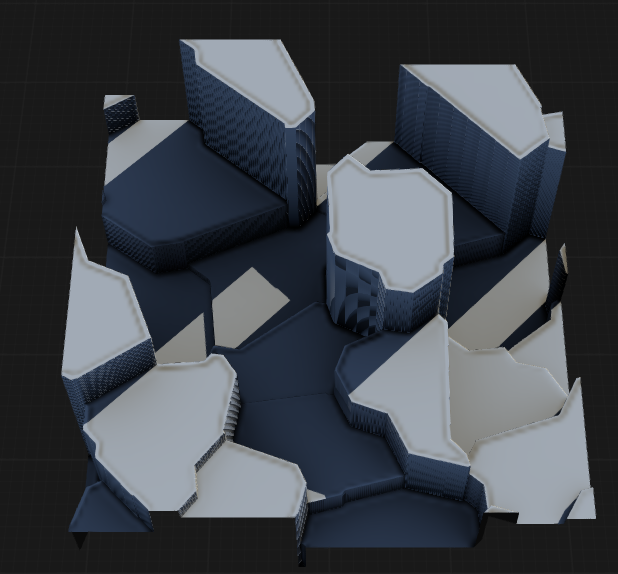
Properties
| Cellular | |
| Size | Controls the overall scale of the cellular pattern. Higher values produce smaller cells (finer detail); lower values produce larger cells (coarser detail). |
| Density | Controls how many feature points are generated per area. Higher density creates more, smaller cells; lower density creates fewer, larger cells. |
| Jitter | Randomizes feature-point placement. Low values are more uniform/structured; higher values create more organic, irregular cells. |
| Metric Morph | Blends between the paired distance behaviors implied by the selected Distance Metric (e.g., Euclidian ↔ Manhattan/Chebyshev), changing cell geometry continuously. |
| Distance Metric | Selects the distance-space used to evaluate the cellular field, affecting the fundamental shape of cells and borders. Euclidian ManhattanMorph between rounded Euclidian cells and diamond-like Manhattan cells (axis-aligned, sharper corners) using Metric Morph. Euclidian ChebyshevMorph between rounded Euclidian cells and square-like Chebyshev cells using Metric Morph. MinkowskiGeneralized metric that spans a continuous family of distance shapes (useful for smoothly varying from rounded to more boxy forms). |
| Coordinate Axes Jitter | Adds jitter in coordinate/axis space before evaluation, warping the field and introducing directional wobble and boundary distortion. |
| CAJ Clustering | Controls how Coordinate Axes Jitter groups together. Low values spread distortion evenly; higher values create patchy/clumped distortion regions. |
| Anisotropy | Stretches the pattern directionally, producing elongated/elliptical cells and emphasizing a dominant direction. |
| Distance Function | Defines what value is output from the cellular field (cell IDs, distances to points, borders, or edges). HashOutputs a stable random value per cell region (cell ID-style mask), useful for random patching, selection, and variation. Distance InvOutputs inverse distance to the nearest feature point (bright centers fading toward borders). Distance 2 InvOutputs inverse distance to the second-nearest feature point, producing a different internal falloff useful for variation and breakup. Distance DiffOutputs the difference between nearest distances (classic Voronoi edge emphasis), great for ridges, veins, and cell borders. Distance to EdgeOutputs distance to the nearest cell border, ideal for crack networks and edge masks when remapped. |
| Seed | Changes the random distribution of feature points without changing other settings. |
 using AngryMonkey