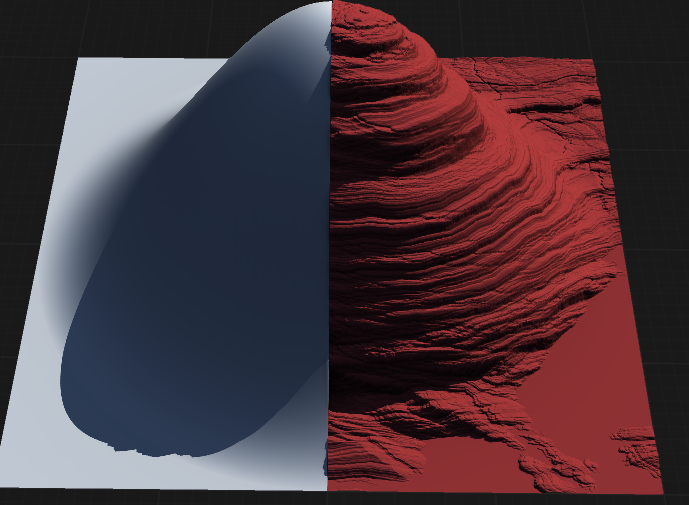
Stratify allows you to create broken strata or rock layers on the terrain in a non-linear fashion. Unlike terracing, stratification involves substrata/subterraces created in confined local zones, such as between two broken plates. Each stratified layer exists independent from the rest of the layer, creating a robust, realistic formation.
When to Use It
Use Stratify when the terrain needs broken rock layering or sedimentary bands that feel uneven and geologic.
Visual Direction
Properties
| Stratify | |
| Spacing | Controls the distance between individual stratified layers, affecting the frequency and thickness of visible strata in the terrain. |
| Octaves | Sets the number of noise octaves used to add variation to the stratified layers. Higher values introduce more complexity and detail. |
| Intensity | Adjusts the overall strength of the stratification effect, making the layers more or less pronounced. |
| Shape | Modifies the profile or contour of the stratified layers, influencing how sharply or smoothly the layers transition. |
| Seed | Defines the randomization seed for procedural generation, ensuring unique but repeatable stratification patterns. |
| Tilt Amount | Applies an angular tilt to the stratified layers, simulating geological tilting or shifting of strata. |
| Direction | Sets the orientation of the stratified layers, determining the primary direction in which the strata are aligned. |
 using AngryMonkey